When to Use Ventarus for Breakdown Support Instead of Waiting for OEM Service
By Ventarus Engineering Services Ltd, engineering services for Chester, North Wales and Merseyside
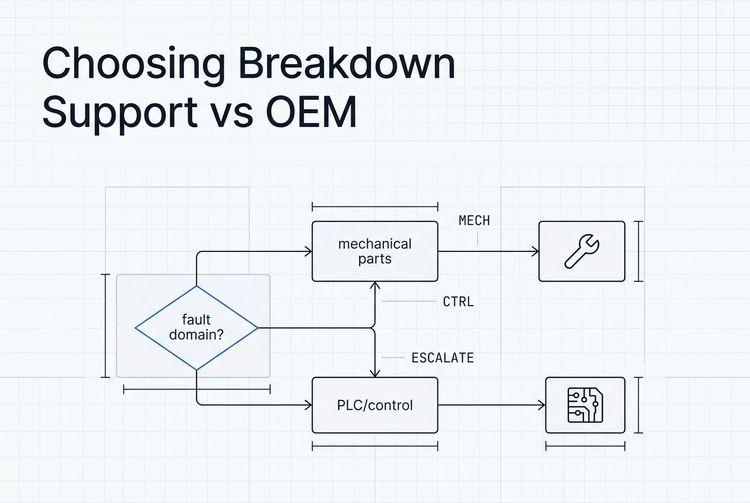
When production is down, the real question is not “independent or OEM?” It’s “who can safely diagnose and restore this fault fastest, in the right way?” If the problem is mechanical, fabricated, structural, guarding-related, or tied to a site-specific repair, Ventarus is a sensible first call for breakdown support. If the fault sits in proprietary controls, firmware, safety systems, or OEM-only parts and procedures, OEM service still needs to lead or come in alongside it.
That split matters because the wrong first call costs time. And when a line is stopped, time is the part you can’t afford to waste.
The fast way to choose between Ventarus and OEM service
The choice gets easier when you stop treating it like a brand decision. It’s a fault-domain decision. Match the responder to the problem, then ask whether you need a repair, a fabricated part, a modification, or a manufacturer-specific intervention.
| Decision criterion | Ventarus / independent engineering support | OEM service |
|---|---|---|
| Best fit | Mechanical, fabricated, structural, guarding/access, modification, and recurring-fault problems | Proprietary controls, software, machine-specific design authority, recalls, OEM-only procedures or parts |
| Response | Can be flexible if local capacity and agreed availability exist. Ventarus’s public wording says business hours are by arrangement | May have a formal support route, but availability depends on contract, geography, backlog, engineer capacity, and the machine |
| Diagnosis | Practical inspection and assessment of the asset and its working environment | Deepest direct knowledge of its own design, controls, documentation, and known failure modes |
| Repair route | Repair, replacement, bespoke fabrication, welding, reinforcement, or modification based on the site problem | Manufacturer-approved repair, OEM parts, OEM procedures, and product engineering escalation |
| Fabrication | Strong fit where a guard, bracket, frame, platform, support, fixture, or replacement fabricated component must suit the layout | Standard replacement or approved component route, but bespoke site fabrication is not automatically part of the package |
| Repeat failure | Can investigate practical cause and propose condition improvement or modification | Can investigate machine-specific design, software, controls, and known product issues |
| Parts | Public material does not confirm stock or universal replacement-part supply, so confirm responsibility before mobilisation | More likely to have direct access to drawings, approved parts, and product engineering escalation, but lead time still needs confirmation |
| Cost | Don’t assume cheaper. Request a scope and estimate | Don’t assume more expensive. Request the actual call-out, labour, travel, parts, and lead-time terms |
| Safety | Must work within the site’s safe system, competence requirements, isolation, guarding, and modification assessment | OEM involvement does not remove the site’s legal and operational duties |
| Best outcome | Fast, practical, durable recovery for the right fault domain, with OEM escalation where needed | Product-specific certainty where the problem is inseparable from the manufacturer’s technology or design |
If this feels like a lot, keep it simple. First ask: is the fault physical, or is it tied to the machine’s proprietary brain? That one question clears up a lot.
Use Ventarus first when the failure is mechanical, fabricated, or site-specific
Ventarus is the better first call when the fault is in the physical work of the machine, not its proprietary logic. That includes broken brackets, worn supports, damaged frames, distorted guards, failed access platforms, cracked fabricated assemblies, loose or misaligned components, and parts that can be measured, repaired, remade, or reinforced on site.
That is where breakdown support becomes practical. You need someone who can look at the asset, understand how it actually lives on the floor, and make a repair that fits the reality of the site. Not every failure needs a manufacturer’s design team. Some need a competent engineer with fabrication and repair options.
This is also where reactive repairs should stay honest. A repair can restore function without pretending the underlying issue is solved forever. If the same part keeps going again, the answer may be in loading, alignment, access, support, or how people work around the asset. Ventarus’s public positioning includes root-cause investigation aimed at looking beyond the immediate fault and helping prevent repeat issues where possible. That’s the right lens here. It’s an investigation and improvement objective, not a promise.
Call OEM service first or alongside Ventarus when the fault is proprietary
Some faults do belong with the OEM. If the problem sits in a PLC, drive, servo, HMI, firmware, software, safety controller, or another proprietary control system, the OEM or its authorised channel is the stronger route. The same is true when the machine’s safe function depends on a proprietary safety circuit, interlock architecture, or safety-related control that can’t be altered responsibly from incomplete information.
Use the OEM first or in parallel when:
-
a recall, safety notice, engineering change, or manufacturer instruction may be involved
-
the repair needs proprietary parts, software updates, calibration, validation, or conformity decisions
-
the installed design tolerances or product data are essential to getting the answer right
-
the site needs a manufacturer-specific decision documented by the OEM
-
the independent provider can’t demonstrate the right competence, risk controls, insurance, method statement, or relevant experience
This is the part people sometimes over-simplify. OEM service is not automatically the answer to every stoppage, but it is the right answer when the fault is inseparable from the manufacturer’s technology or authority.
Use breakdown support for fabricated repairs, not just “get it running”
A lot of downtime problems are more physical than digital. That’s where Ventarus’s fabrication and welding capability matters. The product context supports work from existing drawings, measurements, photographs, samples, or an on-site discussion, which is useful when the plant needs a site-specific repair rather than a catalog part.
That can include:
-
repairing or reinforcing a damaged frame, support, bracket, or machine structure
-
making a replacement bracket, mount, guard, cover, platform, handrail, or support
-
fabricating a bespoke guard or safety enclosure where standard guarding doesn’t fit
-
modifying access or a workstation so maintenance and operation don’t depend on awkward workarounds
-
making fixtures, jigs, or production aids to improve repeatability and handling
-
welding a fabricated assembly or carrying out an on-site metal repair where the material, access, procedure, and competence are suitable
-
strengthening an ageing asset rather than replacing the whole machine, when a competent assessment says that is safe and technically sound
That last point is worth saying plainly. A fabricated repair is not always the right choice. Material, load, fatigue, heat effects, corrosion, tolerance, hygiene, hazardous-area concerns, and safety function all matter. A good repair is the one that fits the equipment and the operating environment. A fast repair that creates a new hazard is just deferred trouble.
Choose Ventarus when the real problem is access, guarding, or usability
Breakdown support is not only about motors and bearings. A damaged guard, poor access point, unsafe workaround, or awkward handling setup can be the thing blocking a safe return to production.
Ventarus’s stated fabrication scope includes machine guards, brackets, frames, and platforms, and its product context adds guarding, access, and workstation improvements. That makes it a useful option when the line can’t be released because the physical setup is no longer safe or workable.
This is a common maintenance trap. A team sees a production issue and thinks only of the failed part. But if operators can’t reach the area safely, if maintenance access is poor, or if a guard is bent and unusable, the stoppage is bigger than the failed component. The repair has to restore safe operation, not just movement.
Do not treat “fabricated” as shorthand for “compliant.” Any replacement guard or access modification needs proper risk assessment, design, installation, and post-work checks. The site still owns safe operation.
Use Ventarus when the same failure keeps coming back
Repeat failures are a sign to stop doing the same thing and hoping for a different result. If a component keeps failing, ask what is loading it, whether the alignment is off, whether support is wrong, whether access encourages poor maintenance, whether the material or thickness is suitable, or whether the operator has been forced into a workaround.
That is exactly where a practical independent engineer can help. Ventarus says it looks beyond the immediate fault to identify causes and help prevent repeat issues where possible. That can mean condition improvement, modification, or a better arrangement around the asset. It can also mean deciding that a reactive repair is not enough on its own.
This is where many sites lose time. They keep buying the same short-term fix and call it maintenance. It isn’t. Reactive repairs restore function. Reliability improvement takes the extra step of asking why the fault keeps showing up.
Use Ventarus for shutdowns, refurbishment, and extra hands
Not every call is an emergency. Some of the best uses of breakdown support happen before the line stops.
The product context positions Ventarus as additional capacity for planned preventative maintenance, reactive repairs, shutdown/refurbishment work, and stretched in-house teams. That matters for maintenance managers who are already carrying too much. It gives you another pair of hands and, more important, another set of fabrication and repair capabilities when the shutdown work pack is bigger than your team can absorb.
This is where planning pays off. If you know a part may need fabrication, don’t wait for the shutdown window to find out. Confirm drawings, measurements, access, isolation, and any lead times ahead of time. Ask who supplies steel, consumables, standard parts, and replacement guards. Ask what testing will be needed before restart.
You don’t need every detail settled on day one. You do need the pieces that can turn a controlled shutdown into a clean one.
Keep the safety boundary clear
The right contractor still has to work inside the site’s safety rules. That doesn’t change because production is down.
Before maintenance or repair, moving plant has to be made safe, energy sources isolated, and lock-off used where power could be restored accidentally. That includes electrical, mechanical, hydraulic, and pneumatic energy, not just the main isolator. Maintenance should be carried out by competent people with enough information, instruction, and training. If someone can’t demonstrate competence, they shouldn’t work without suitable supervision.
Hot work needs special care. Welding and repair work bring fire, explosion, fumes, radiation, burns, and confined-space risks. HSE notes both acute and long-term health risks from welding fume, and it estimates that breathing metal fume at work leads to 40 to 50 welders being hospitalised each year. It also warns that welding in confined spaces can cause death by asphyxiation and should only be done when absolutely necessary.
So yes, Ventarus can fabricate and weld. That is not the same as saying every job should be welded, every repair should be temporary, or every machine can go straight back into service. It means the repair route can include those options when they are the right ones, under the right controls.
Ask the right questions before you appoint anyone
When production is down, the wrong questions waste time. Ask the ones that change the outcome.
-
Can you attend in the window I actually need?
-
Do you cover this equipment type and failure mode?
-
Can you diagnose mechanical and fabricated issues on site, or is this assessment-only?
-
Can you repair the existing component, make a replacement, reinforce it, or modify the surrounding equipment?
-
Will you work from measurements, photographs, drawings, a sample, or an on-site survey?
-
Who supplies proprietary parts, standard parts, steel, consumables, and replacement guards?
-
What information should I send before attendance?
-
What isolation, permits, lifting, access, hygiene, hazardous-area, and hot-work controls are required?
-
What evidence of competence, insurance, risk assessment, method statement, and inspection documentation applies?
-
Is the proposed remedy temporary or permanent, and what follow-up work is required?
-
What will be tested before the line goes back into production?
-
What happens if the fault turns out to be controls-related or needs OEM escalation?
These questions don’t add bureaucracy. They cut it.
A practical rule for the next breakdown
Don’t choose by habit while the line is down. Choose by fault domain.
Call Ventarus when the urgent problem is mechanical, fabricated, structural, site-specific, or improvement-led, and you need an assessment-based practical repair conversation. Call or escalate to the OEM when proprietary controls, safety systems, product-specific parts, recalls, or manufacturer design authority are central. If the fault crosses both domains, use both routes. Let the mechanical repair move while the controls issue gets the manufacturer’s attention.
That is the cleanest way to reduce delay without guessing.
If you need to discuss a breakdown, send the machine make and model, asset number, exact symptom, alarms or fault codes, photos or video where safe, drawings or measurements, access constraints, hazards, and whether you need a temporary recovery or a permanent repair. Ventarus can review the problem, confirm scope, and talk through availability before mobilisation.
FAQ
Should I call Ventarus or the OEM first when a machine stops?
Call according to the fault domain and urgency. Ventarus is a good first call for mechanical, fabricated, structural, guarding/access, modification, and recurring-fault work. The OEM is the stronger first or parallel route for proprietary controls, software, safety systems, recalls, manufacturer-specific diagnostics, and OEM-only parts. If you’re not sure, give both the same structured information and ask what each can safely cover.
Can Ventarus make a replacement part if the OEM part is delayed?
The product context says Ventarus can provide fabricated replacement parts and can work from drawings, measurements, photographs, samples, or an on-site discussion. That doesn’t mean every OEM part can be replicated, or that every replacement is automatically safe or suitable. Material, tolerance, load, safety function, hygiene, conformity, and inspection all need to be checked first.
Does independent breakdown support mean the OEM is no longer needed?
No. Independent support and OEM service are complementary. The OEM may still be essential for proprietary controls, machine-specific design information, software, safety systems, recalls, calibration, or manufacturer-only parts. Ventarus may be the right fit for the physical repair, fabrication, modification, or site problem while the OEM handles the product-specific issue.
Does Ventarus offer 24/7 emergency response?
The public material reviewed does not state a 24/7 service or a guaranteed response time. It says business hours are by arrangement. Confirm current availability, response expectations, geography, call-out terms, and scope directly before relying on Ventarus for an urgent incident.