
How to Compare Shutdown Welding Contractors With a Practical Scorecard
By Ventarus Engineering Services Ltd, engineering services for Chester, North Wales and Merseyside
If you’re comparing shutdown welding contractors for a planned outage, the hard part isn’t finding names. It’s telling which bidder can deliver safe, compliant work inside your real shutdown window. A low hourly rate won’t help if the contractor can’t handle isolation, access, inspection, or handback.
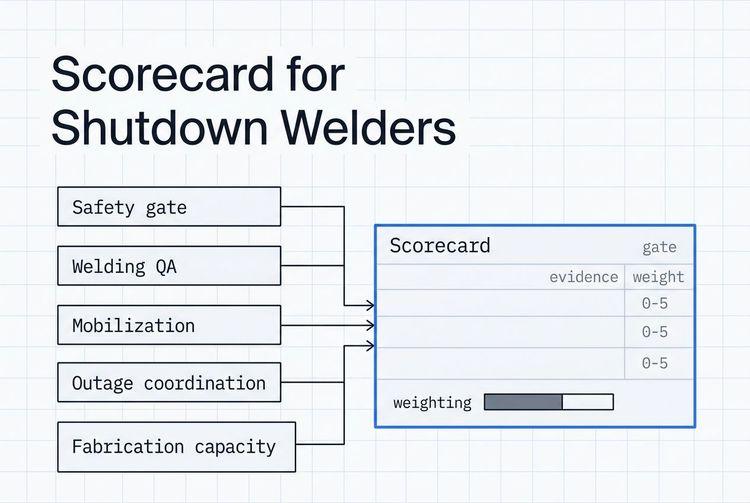
The way through this is to stop comparing promises and start comparing evidence. Use one scope pack, the same hard safety gates, and a weighted shutdown work scorecard that makes it harder for a polished bid to hide weak delivery.
1. Define the shutdown work package before you invite bids
A fair comparison starts before the first quote lands. If every bidder is pricing a different version of the job, you’re not comparing contractors. You’re comparing assumptions.
Start with a clear scope pack . For each work item, record the asset, exact location, access route, repair or fabrication need, drawings or photos, material details where known, damage description, tolerances, finish, inspection needs, isolation requirements, hot-work controls, and the shutdown dates and handback deadline. Add the interfaces too. Production, maintenance, engineering, operations, and other trades all affect the real work.
Then split the job into line items. Site survey, engineering review, preparation, fabrication, on-site welding, inspection, coating, testing, and handover should not all be buried in one lump sum. That hides risk and makes later comparison messy.
This is also where you force honesty about uncertainty. Ask bidders to list assumptions and exclusions, not just price. What did they assume about material, thickness, or hidden damage? What could trigger a variation? What temporary make-safe action can they take if the permanent fix needs more engineering? If they can’t answer that, they’re not ready for shutdown work.
2. Apply safety and competence gates before you score anything else
Before you compare price or schedule, decide whether the bidder clears the basic safety line. A cheap bid cannot make up for missing controls on hot work, isolation, supervision, or fume management.
Ask for task-specific risk assessments and method statements, hot-work and permit-to-work arrangements, isolation and lockout/tagout controls, emergency response, welding-fume controls, PPE and respiratory protection, training records, a named site supervisor, subcontractor controls, relevant insurance evidence, and references from comparable industrial shutdown work. Verify the evidence. Don’t accept “fully compliant” as a substitute for documents.
There are also hard stops. No task-specific RAMS. No credible isolation plan. No named competent supervisor. No suitable fume controls. Refusal to work under the site permit system. Any of those is a reason to reject or pause the bid, no matter how good the number looks.
Welding, cutting, and grinding count as hot work, so the permit route matters. The plant owner normally controls authorization, isolation, and handback. The contractor supplies the task controls and follows the site system. If a bidder assumes it can self-authorize the permit, that’s a problem, not a convenience.
What to check on welding fume controls
This is one place where people get pushed into vague answers. Don’t let that happen.
The method statement should name the welding process, the base metal, the consumables, the amount of work, and the fume risk. Then check the control order. First, can the work be reduced or avoided? If not, can the weld be shortened or the process changed? If not, is local exhaust ventilation suitable? If LEV won’t do it, what respiratory protection and nearby-worker controls are in place?
For occasional welding, less than once per week and under one hour, engineered fume controls are not normally expected, but suitable RPE and effective general ventilation are still needed. For outdoor welding, LEV can’t be relied on to capture fume effectively, so RPE and protection of others still matter. For arc welders, HSE identifies powered-air or supplied-air respiratory protection with an assigned protection factor of at least 20 as the best option. Tight-fitting RPE also needs face-fit testing.
Ask for LEV maintenance and examination records. HSE says LEV must be thoroughly examined and tested at least every 14 months. That’s a useful check when a contractor says it has extraction in place. On-torch extraction can work for MIG welding when it suits the task, but capture velocity is not the right test for that setup. What matters is whether the fume is actually controlled.
3. Compare welding quality assurance, not just welder experience
Here’s where most buyers lose time. They ask whether the contractor can weld, when the real question is whether it can produce the required weld, on the required material, under the required code, and prove it.
Start with the governing standard for each work package. AWS D1.1 applies to structural, load-bearing steel work when that code is relevant to the job. It is not the universal answer for every industrial weld. ISO 3834 gives a framework for welding quality requirements, and ISO 14731 deals with welding coordination. None of those are a shortcut around the actual design code, project specification, or plant requirement.
Then separate the documents. A WPS tells you how the weld will be made. A procedure qualification record shows that the procedure has produced acceptable test results. A welder qualification record shows the individual can make that weld within the qualifying range. One does not automatically cover the other.
Ask each bidder these questions:
-
What code or specification governs this package?
-
Which WPS applies to each proposed weld?
-
What procedure qualification supports it?
-
Are the proposed welders qualified for the process, material, position, and thickness range?
-
Who is responsible for welding coordination?
-
Who checks fit-up, preheat, interpass temperature, and final appearance?
-
What inspection or NDE is required?
-
Who performs it, and under what written practice?
-
How are welds linked to records and traceability?
-
How are nonconforming welds repaired and re-approved?
-
What records are handed over at completion?
-
What happens if the existing material or condition differs from the drawing or bid assumption?
Do not award a strong QA score just because someone has certificates in a folder. You need the match between the job, the material, the position, the process, and the range of qualification. If that chain breaks, the certificate doesn’t carry the work.
4. Test mobiliation before you award the work
A contractor can own good welding gear and still fail a shutdown because it can’t mobilize properly. For your purposes, mobilization means the right people, the right tools, and the right controls arriving together.
Ask for named crew members, roles, and availability. Ask who the project manager and site supervisor are. Ask what welding sets, backup machines, power supplies, leads, extraction, lighting, and consumables will come to site. Ask about access equipment, lifting equipment, work-at-height equipment, travel, induction, and permit readiness. If the work might run nights or weekends, get that in writing too.
Be careful with “fast response.” Fast from when? Call time, scope confirmation, permit approval, or site access? Attendance, assessment, make-safe work, and permanent repair are not the same thing. If the bidder won’t define that, the claim is not useful.
For a planned shutdown, some coordination guidance suggests prequalification and scope definition 12 to 16 weeks ahead, integrated planning 8 to 12 weeks out, and onboarding 1 to 2 weeks before execution. Treat that as a practical planning envelope, not a rule. If the shutdown is close, you can compress the process, but you should not drop the evidence checks.
5. Verify fabrication capacity and field practicality
A good site welder is not automatically a good fabrication partner, and a strong fabrication shop may still be poor at working safely around a live industrial site. Score those as separate strengths.
For fabrication, ask about MIG and TIG capability for the materials and finish you need. Ask what is done in-house and what is outsourced, including cutting, drilling, bending, rolling, machining, and coating. Ask for practical limits on component size, weight, handling, and installation. Not because there’s one universal threshold, but because the contractor should know its own limits.
Also ask how it builds from drawings, samples, templates, photos, or site measurements. Ask about drawing control, dimensional checks, trial assembly, material traceability, piece marking, and preassembly. If the job involves replacement parts, jigs, frames, brackets, guards, platforms, or supports, those details matter more than a polished capability statement.
This is where many shutdown welding contractors look similar on paper and very different in practice. One can quote a fabrication job. Another can actually deliver it in the space and time you have. That difference shows up in handling, access, and inspection, not marketing copy.
For repairs, you also need before-and-after identification of the affected asset and a record of what was removed, added, reinforced, or altered. Without that, handback becomes a guessing game later.
Ask for comparable examples, process and equipment lists, component limits, dimensional-control methods, in-house versus outsourced work, traceability, inspection records, and a plan for scaling up if the scope grows.
6. Treat guarding modifications as safety changes, not ordinary metalwork
Guarding work is easy to underprice because it looks like simple fabrication. It isn’t. A guard can be strong and still be wrong if it creates reach-through access, blocks visibility, interferes with emergency stops, or becomes easy to defeat.
Ask the bidder what hazard the guard is meant to control. Ask how the risk was assessed, whether normal operation or maintenance needs access, and whether a fixed guard, interlocked guard, trip device, or other safeguard is the right choice. Ask how gaps, openings, edges, visibility, cleaning, ventilation, and hygiene are handled. Ask how the final design is approved.
The key point is simple. The contractor can fabricate and install the physical solution, but the plant owner still owns the safety decision. If a bidder acts as though the welding job and the safety sign-off are the same thing, stop there.
7. Score outage coordination and handback discipline
This is the part that saves shutdowns from turning into stories people repeat for the wrong reasons. Good technical work still fails if the contractor blocks access, misses a predecessor task, or leaves you with an unclear handback.
Require a simple integrated schedule. It should show work by asset and location, dependencies, isolation and permit prerequisites, material and fabrication dates, inspection hold points, critical path activities, crew loading, access and lifting dependencies, interfaces with other trades, and the handback window.
Then ask how the contractor handles discovered work. Hidden damage is common in shutdowns. The response should be disciplined: stop, make safe, record the condition, explain the impact, offer repair or temporary make-safe options, get authorization, update the schedule, and document the decision. If that process is missing, variations can run without control.
Handover matters too. The work is not finished when the arc stops. You need the area cleared, tools and gas bottles removed, temporary supports and fire-watch controls taken away only when safe, guards and covers installed, permits closed, inspection records received, drawings updated, and the responsible operator accepting the handback.
Recommended shutdown work scorecard
Use this as a starting point, not a universal formula. The right weight changes with the job. A structural repair, a hygienic modification, a non-structural bracket, and a pressure-related weld do not carry the same risk.
| Criterion | Weight | What to assess | Evidence to request |
|---|---|---|---|
| Safety and site control | 25% | Risk assessment, hot work, isolation, fume, supervision, emergency response, incident control | RAMS, permit process, fume plan, supervisor credentials, incident data, references |
| Welding QA and technical compliance | 20% | Governing code, WPS/PQR, welder qualifications, welding coordination, inspection, NDE, traceability | WPS, procedure qualification evidence, welder records, quality plan, sample inspection pack |
| Outage coordination and handback | 20% | Integrated schedule, dependencies, critical path, discovered-work control, daily coordination, closeout | Sample schedule, daily report template, change process, handover checklist |
| Mobilization and responsiveness | 15% | Crew availability, equipment, shifts, backup, travel, induction, permit readiness | Crew plan, equipment list, mobilization plan, contingency plan |
| Fabrication capacity and field practicality | 20% | Relevant welding processes, bespoke fabrication, dimensional control, material handling, installation | Comparable examples, facility list, capacity limits, inspection process |
Use a 0 to 5 scale for each criterion:
-
0, unacceptable: no evidence or a failed mandatory requirement.
-
1, weak: big gaps, generic promises, heavy buyer intervention needed.
-
2, limited: basic capability, but important gaps remain.
-
3, acceptable: meets the requirement with credible evidence.
-
4, strong: exceeds the requirement and shows relevant comparable work.
-
5, outstanding: current, specific, directly comparable, and backed by a robust delivery system.
Score each criterion, apply the weight, and add the results to get a score out of 100. Keep price as a separate commercial check, or a modest factor at most. If you compare commercial value, look at total evaluated cost, exclusions, overtime, access equipment, inspection, travel, variations, and expected rework. Hourly rate alone tells you very little.
A simple rule helps here. Don’t award a safety score above 2 without task-specific evidence. Don’t award a QA score above 2 without relevant procedure and welder evidence. Don’t award a mobilization score above 2 without a named crew and equipment plan. Don’t award an outage coordination score above 2 without a sample schedule and handback process.
8. Validate the preferred bidder before award and review after the shutdown
Once you have a preferred bidder, do one more pass before award. Confirm the named people, the documents, the assumptions, the permit route, the handback process, and the commercial exclusions. If anything has shifted since the bid, now is the time to catch it.
For a complex shutdown, this is also the moment to compare the plan against your own reality. Do the isolations line up with your permit system? Are the access points workable? Are the inspection hold points realistic? Will the work still fit if one predecessor task slips? That check costs little compared with a shutdown overrun.
After the shutdown, review performance while it’s still fresh. Record what the contractor actually delivered, where the plan held, where it didn’t, and what should change next time. HSE’s contractor-management approach is built around planning the job, choosing a competent contractor, managing the work on site, checking progress, and reviewing performance afterward. That’s the right loop here too.
If this feels like a lot, it is. But you do not need to solve all of it at once. Start with the gate that costs you the least time: a single scope pack, a hard safety check, and a practical shutdown work scorecard. That will tell you more than a stack of polished bids ever will.
FAQ
What should I score first when comparing shutdown welding contractors?
Start with the hard safety and competence gates. Then score safety, welding QA, outage coordination, mobilization, and fabrication capacity using the same evidence requirements for every bidder.
Is the cheapest quote usually the best choice for shutdown work?
Not usually. A lower rate can be wiped out by exclusions, weak planning, rework, missed handback, extra access costs, or shutdown overruns.
Do all industrial weld repairs need AWS D1.1?
No. AWS D1.1 is for structural steel work when that code is the right one for the job. The governing code depends on the asset, service, material, and contract.
What documents should a welding contractor provide before work starts?
At minimum, ask for the task-specific risk assessment and method statement, permit and isolation interface, proposed crew and supervisor, applicable WPS and qualification evidence, fume-control plan, inspection plan, schedule, and handback requirements.
How far ahead should I appoint a shutdown welding contractor?
For a complex planned shutdown, prequalification and scope definition 12 to 16 weeks ahead is a useful planning guide from secondary coordination advice. It isn’t a universal rule. The real timing depends on scope, approvals, materials, access, permits, and the shutdown date.
How do I assess fabrication capacity without overcomplicating it?
Ask for comparable examples, process and equipment lists, component limits, dimensional-control methods, in-house versus outsourced work, traceability, inspection records, and a plan for scaling up if the scope grows.
Who owns the final decision on a guarding modification?
The contractor can fabricate the guard, but the plant’s responsible engineering or safety authority should confirm that the hazard is controlled and the modified equipment is suitable for use.
When you compare shutdown welding contractors this way, you stop buying labour and start buying controlled delivery. That’s the point of a practical industrial welding contractor comparison. It makes the differences visible before the shutdown starts, when you still have time to choose the bidder that can complete durable work and hand the plant back safely.
If you need support with a repair, guarding modification, or fabricated steel part, Ventarus Engineering Services can work from photos, drawings, or a site visit, define a practical solution, and plan the work around your outage constraints.