
Factory Engineering Services Across North Wales, Cheshire, and Merseyside Explained Clearly
By Ventarus Engineering Services Ltd, engineering services for Chester, North Wales and Merseyside
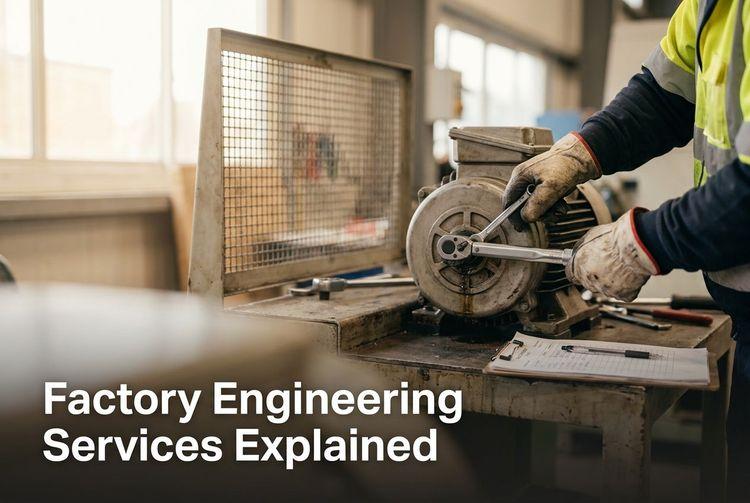
If you’re trying to decide what kind of help a plant actually needs, that’s the right question to start with. Factory engineering services are not one job. They cover breakdown support, planned maintenance, fabrication, welding, guarding, equipment modification, process improvement, and shutdown work. The job is to match the symptom to the right intervention, so you fix the problem without creating a new one.
That matters because most sites do not need “more engineering” in the abstract. They need the right kind at the right time. A stopped line needs a different response from a repeated failure. A poor-fit guard needs a different answer from a cracked bracket. A shutdown window needs a different plan from a live production repair.
What factory engineering services cover
Factory engineering services is a broad label, not a single package. In practice, it usually means hands-on support for manufacturing plant maintenance, reactive repairs, fabrication, welding, machine modifications, process improvement, and planned shutdown work.
For a maintenance manager, the useful question is not “Do we need engineering?” It’s “What problem are we solving?”
That could be:
-
A machine has failed and production is waiting.
-
An asset keeps breaking in the same place.
-
A guard or access point does not suit the real machine layout.
-
A steel part is cracked, worn, or missing.
-
Planned maintenance is slipping because your in-house team is stretched.
-
A shutdown window is coming up and you need extra capacity.
Ventarus Engineering Services works in that practical middle ground. The focus is assessment first, then the right repair, modification, or fabricated solution for the job in front of you. That approach matters more than a long list of capabilities.
Breakdown support and reactive repairs
When production has already stopped, the first job is to understand the failure. Not every breakdown needs a full rebuild. Not every fault needs a replacement part. The right response starts with inspection and a clear decision on whether to repair, replace, fabricate, reinforce, modify, or use a temporary engineered solution.
That is the part many teams get stuck on. They feel pressure to move fast, so they jump straight to the fix. But a fast fix that doesn’t match the failure can waste time twice.
Reactive support is the right fit when:
-
A critical machine has stopped.
-
A component has failed or become unsafe.
-
A damaged bracket, frame, or structure is preventing operation.
-
The in-house team lacks the time or specialist fabrication capacity to resolve it quickly.
Ventarus’s breakdown support is assessment-led. The work can include damaged component repairs, weld repairs, reinforcement, fabricated replacement parts, and mechanical repair work to restore operation. Temporary or permanent engineered solutions are part of that scope too, which is useful when a line needs to run before a fully permanent replacement can be made.
The important distinction is this: a temporary repair may buy production time, but it is not automatically the final answer. If the underlying weakness is still there, the job may need follow-up work. That’s the difference between restoring output and just postponing the same failure.
Planned maintenance and recurring-failure improvement
Planned maintenance is not just “doing jobs earlier.” It is scheduled work intended to keep assets safe, reliable, and fit for operation before a failure disrupts output.
Use it when the failure pattern is already telling you something.
If the same issue keeps coming back, reactive repair alone is usually the expensive way to stay busy. The site may be dealing with wear, poor access, looseness, cracking, vibration, contamination, or an operating method that keeps stressing the same point. In that case, you want condition improvement, not another patch.
Planned work is a good fit when:
-
The asset is safety-critical or production-critical.
-
You already know the failure pattern.
-
Wear or deterioration can be seen before failure.
-
Your maintenance backlog is getting too long.
-
The work can be done before start-up or during a planned outage.
This is also where root-cause thinking matters. Ventarus states that it can support root-cause investigation for repeat failures where required. That doesn’t mean every failure can be eliminated. It does mean you can look past the symptom and ask why the part keeps failing in the first place.
Here’s the simple test:
-
One isolated failure may only need repair.
-
Repeat failures usually need a change in support, access, load, material, or operating method.
-
If the same fault keeps returning, the repair probably needs to become a modification.
That’s the part worth your afternoon. The rest can wait.
Bespoke steelwork, fabrication, and welding
Sometimes the problem is not a failed machine. It’s a fit problem.
Off-the-shelf parts do not always suit the machine layout, the access constraints, or the working environment. That’s when bespoke fabrication becomes the sensible route. It can solve a problem that standard product ranges just don’t reach.
Factory engineering services often include:
-
Machine guards and safety enclosures
-
Frames, supports, brackets, stands, mounts, and housings
-
Platforms, walkways, and handrails
-
Workbenches, trolleys, and material-handling aids
-
Replacement machine parts and repair sections
-
Protective structures and site-specific modifications
-
Fixtures, jigs, and production aids
Ventarus confirms industrial fabrication from drawings, measurements, photographs, samples, or site discussion. That matters because many jobs are not fully defined on paper. You may know the machine, the problem, and the space you’ve got, but not the exact final shape yet. Good fabrication work starts there.
Welding sits inside that larger repair and fabrication picture. Ventarus lists MIG welding and TIG welding, along with on-site welding repairs, structural repairs, reinforcement, machinery modifications, and fabricated assemblies.
Use this kind of work when:
-
A steel frame or support has cracked or deformed.
-
A worn part needs a repair section or replacement.
-
An existing asset should be reinforced instead of replaced.
-
A fabricated assembly needs joining or changing on site.
-
A machine needs an altered support, bracket, or mount.
The useful question is not “Can it be welded?” It’s “What outcome does the repair need to deliver?” Material, thickness, access, finish, and loading all affect the right approach. Welding is a tool, not the whole answer.
Machine guarding, access, and equipment modifications
If operators can reach dangerous moving parts, ejected material, or other hazards during normal use, cleaning, adjustment, or maintenance, guarding is not optional. It is part of making the machine safe enough to use.
This is where many sites run into the same problem. A standard guard does not fit the machine. Or the machine has changed over time, so the old guard no longer suits the real layout. Or access is so awkward that people remove, bypass, or work around protection to keep the line going.
That is exactly when bespoke guarding and access changes earn their keep.
Typical work in this area includes:
-
Fixed machine guards
-
Safety enclosures
-
Protective barriers
-
Access gates or panels where appropriate
-
Guarding integrated with platforms or walkways
-
Handrails, anti-slip surfaces, and service access improvements
-
Replacement or repair sections for damaged guards
Ventarus also lists equipment modifications, guarding and access improvements, and strengthening or reinforcement. That can be the right move when the machine still has life in it, but the current setup no longer works for the process or the people running it.
The point is not just to make equipment look neater. It is to make it safer, easier to inspect, easier to maintain, and less likely to push operators into risky workarounds.
One caution matters here. A fabricated guard is not automatically compliant just because it is made from steel. Any modification needs to be assessed against the machine’s risk and safety requirements.
Shutdown and refurbishment assistance
Some work should not be done while the line is live. If the job is intrusive, extensive, or risky to complete around production, it belongs in a controlled shutdown or refurbishment window.
That can include:
-
Internal inspection
-
Structural repair
-
Replacement of multiple worn components
-
Guarding changes
-
Access-platform installation
-
Major reinforcement
-
Planned maintenance packages
Ventarus includes shutdown, refurbishment, and planned works in its service material, with support delivered during agreed production stoppages. That kind of support matters when your in-house team can handle part of the work but not the whole package.
This is where planning gets serious. A shutdown job is not just a pile of tasks squeezed into a weekend. You need the asset list, the scope, the access needs, the isolation arrangements, the permit controls, the hand-back requirement, and the acceptance criteria. If any of those are vague, the outage tends to grow legs.
A good shutdown brief answers:
-
What equipment is in scope?
-
What needs to be finished before restart?
-
What access, lifting, and workspace is needed?
-
Who controls the plant and the isolations?
-
What safety constraints apply?
-
What counts as acceptable completion?
That level of preparation is not extra bureaucracy. It is what keeps a planned outage from turning into a dragged-out one.
How to choose the right intervention
If you only take one thing from this article, make it this: start with the plant problem, not the service name.
Here’s the simplest way to decide.
If production is stopped
Start with breakdown support and assessment. Do not assume fabrication is needed until you know what failed.
If the same fault keeps coming back
Move beyond repair and look at planned maintenance, condition improvement, and root cause.
If the issue is fit, access, or layout
Think bespoke fabrication, guarding, brackets, platforms, handrails, or workstation changes.
If the risk comes from contact with moving parts
Prioritise guarding or protective devices. A warning label is not the same thing.
If the work is too intrusive for live production
Plan it for a shutdown window.
If the change alters the machine’s function or safety strategy
Review the modification before it goes in.
If welding is involved
Check the access, the material, the environment, and the controls needed for fume, fire, and nearby workers.
If the site is stretched
Ask what evidence you can give up front. A description, photos, drawings, dimensions, samples, access details, and the needed completion window all help the job move faster.
That’s usually enough to narrow the choice without overcomplicating it.
Why this matters across North Wales, Cheshire, and Merseyside
The regional context matters because these are not quiet industrial areas. North Wales has a broad advanced-manufacturing base, including aerospace, automotive, advanced manufacturing, compound semiconductors, robotics, and other engineering-heavy activity. Cheshire and Warrington’s strategic plan places manufacturing and advanced engineering at the centre of the area’s economy. Merseyside and the Liverpool City Region also have a strong manufacturing presence across automotive, chemicals, pharmaceuticals, food, and consumer goods.
In other words, the same kind of engineering problem shows up across very different sites:
-
A food plant needs safer access and better hygiene-friendly modifications.
-
An automotive or components site needs reliable breakdown support and repeat-failure fixes.
-
A processing site needs fabrication that fits a tight layout.
-
A warehouse or industrial facility needs guards, supports, or handling improvements that work in the real space.
Ventarus serves North Wales, Cheshire, Merseyside, and UK-wide projects by arrangement. That regional spread makes sense because the work is practical, not generic. The same service label can mean a very different job depending on the plant, the process, and the constraints on site.
You do not need a one-size-fits-all answer. You need the right intervention for the site in front of you.
FAQ
What is included in factory engineering services?
They can include planned maintenance, reactive repairs, breakdown support, fabrication, welding, machine guarding, access improvements, equipment modification, process improvement, and shutdown work. The exact scope depends on the site and the engineering provider.
When should I call for breakdown support?
Call when a fault, failure, or damaged component has disrupted production and your in-house team can’t safely or quickly resolve it. The right answer may be repair, replacement, fabrication, reinforcement, or a temporary engineered solution.
Is planned maintenance different from reactive maintenance?
Yes. Planned maintenance is scheduled to reduce risk and deterioration. Reactive maintenance starts after a failure or defect. If the same fault keeps returning, you probably need condition improvement or root-cause work as well.
Can a contractor make a replacement machine part?
Yes, a fabricator may be able to produce a replacement part from drawings, measurements, photographs, samples, or an on-site assessment. Suitability still depends on the real dimensions, loads, interfaces, and safety needs.
Does Ventarus publish prices or response times?
No published price list, rate card, or universal emergency response time was confirmed in the material reviewed. Response availability is agreed in advance.
Close
The simplest way to buy the right help is to start with the failure, the access problem, or the planned outage. A stopped line may need breakdown support. A repeat failure may need condition improvement. A poor-fit or damaged part may need bespoke fabrication. Unsafe access may need guarding or a platform. Intrusive work may belong in a controlled shutdown.
That is the matching principle that keeps the job smaller than it first looked.
If you’re weighing up a machine fault, a fabrication need, a guarding issue, or a planned shutdown, send through the equipment details, the symptom, and any photos or drawings you have. That’s usually enough to work out which engineering route makes sense.