
Best Engineering Partner for Recurring Production Line Stoppages
By Ventarus Engineering Services Ltd, engineering services for Chester, North Wales and Merseyside
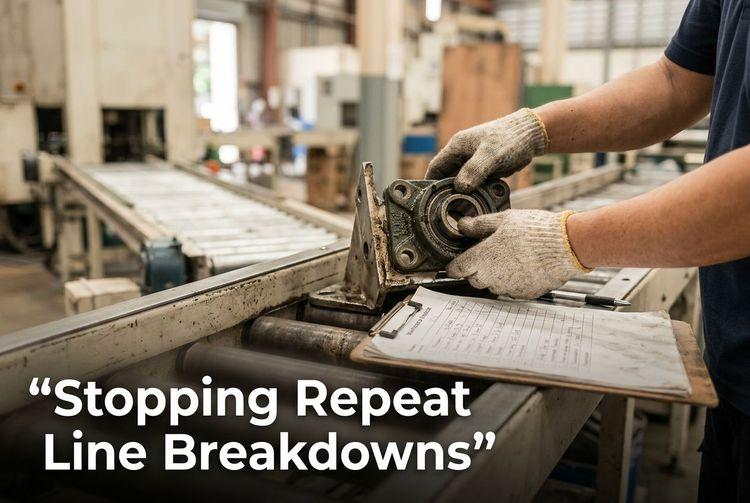
Recurring production line stoppages are not just a repair problem. They are a supplier-choice problem.
If the same fault keeps coming back, you do not need another contractor who can only get the machine moving once. You need an engineering partner who can make the plant safe, diagnose what is really happening, repair or replace the damaged part, fabricate or modify what is needed, and follow the job through until the fix holds in the working environment.
That is the standard this article uses. If you are a maintenance manager dealing with repeat breakdowns, that is the standard worth holding. The rest is noise.
A repeat stoppage needs more than another temporary repair
The first mistake most sites make is treating a recurring failure like a one-off event. It might not be. The visible fault can be the last point in a longer chain involving loading, support, alignment, access, guarding, wear, handling, installation, or a change in the process.
That is why the right supplier is not just the one who can turn up fast. It is the one who can decide, with you, whether the right answer is repair, replacement, reinforcement, fabrication, modification, or a temporary engineered solution while the permanent work is planned.
For you, that matters because repeat stoppages drain more than time on the line. They pull attention from planned work, increase pressure on your team, and make a short-term fix look like a long-term plan. If the same failure keeps returning, the supplier has to do more than close the call-out.
What you want to hear early is this: here is what we know, here is what we still need to check, here is what can be done now, and here is what has to wait for a proper shutdown. That is the difference between a call-out and an engineering partner.
Look for repair capability that goes beyond the failed part
A good repair starts with context, not with a replacement order. The supplier should inspect the damaged component and the surrounding assembly, ask what has failed before, and look at what was done last time. If the same part keeps failing, replacing it again without checking the wider condition is just repeating the first mistake.
For recurring stoppages, the supplier should be able to handle:
-
damaged component repair
-
mechanical repair support
-
component replacement
-
condition improvement around the failed area
-
temporary containment when production needs an immediate recovery
-
a clear permanent repair plan
That list matters because the visible failure is often not the whole problem. If a bracket is bent, a support is weak, an access point is awkward, or a guard forces poor handling, the new part may fail the same way unless the surrounding issue is fixed too.
This is where many sites stall. They keep asking, “Can you fix it?” The better question is, “Can you restore it and improve what made it fail?” That is the question a useful engineering partner should be ready to answer.
Check for fabrication and welding capability
Recurring failures often involve parts that are cracked, worn, bent, poorly supported, or no longer available as standard items. In those cases, fabrication reduces handoffs. It lets one team deal with the physical problem instead of sending you between a repairer, a fabricator, and a separate installer.
Look for practical capabilities like these:
-
MIG welding
-
TIG welding
-
structural repairs and reinforcement
-
on-site welding repairs
-
bespoke brackets, mounts, and supports
-
frames, platforms, walkways, handrails, and barriers
-
replacement machine parts
-
machine guards and safety enclosures
That is not a signal to fabricate everything. It is a signal that the supplier can make the right part when the right part does not exist off the shelf. The fabricated solution still has to fit the load, the environment, the clearances, and the maintenance access your site needs.
This is one reason Ventarus is relevant to this problem. Its published fabrication scope includes bespoke steelwork and site-specific engineering solutions, from guards and support structures to replacement parts and reinforcements. For a repeat failure, that kind of reach matters more than a generic promise to “have a look.”
Make root-cause investigation part of the brief
If the same failure keeps coming back, the supplier should be able to do more than repair the symptom. It should be able to carry out root cause investigation where required and turn that into corrective action.
In practical maintenance terms, that means:
-
define the repeat failure clearly
-
collect the evidence you already have
-
inspect the failed part and the surrounding equipment
-
separate the symptom from the cause
-
test plausible explanations against the evidence
-
choose the right corrective action
-
implement it safely and verify the result
-
record what changed
That sounds formal, but it does not have to be heavy. The point is simple. A broken part is not always the reason it broke.
Sometimes the issue is support. Sometimes it is access. Sometimes it is alignment, loading, vibration, protection, or a process change. Sometimes there are several contributing factors. A good supplier should be able to work through that without treating every job as if it were the same.
A useful distinction here is containment versus corrective action. Containment restores safety or operation while the proper fix is being arranged. Corrective action changes the condition that allowed the failure to repeat. Both can be legitimate. They are not the same thing.
If a supplier cannot explain that difference, keep looking.
Choose a partner who understands production constraints
The best technical answer is not much use if it cannot fit the way your site runs. You need a supplier who understands that your work is shaped by shutdown windows, live production, restricted access, hygiene or contamination controls where relevant, isolation requirements, site permits, and the need to keep other lines running.
That is why response availability should be agreed in advance. The public information for Ventarus does not promise a fixed emergency response time or 24/7 coverage, and you should not assume either. What matters is whether the job can be planned around your access and downtime constraints.
A good supplier conversation should make these points clear:
-
what can be done immediately
-
what needs a planned stoppage
-
what information is needed before arrival
-
what the handover point will be
-
what could extend the job
-
what the likely risks are if the work changes on site
That kind of planning is not admin for its own sake. It is what keeps a repair from becoming a second production problem.
Ventarus states that it works alongside production and maintenance teams, which is the right model for a stretched site. You keep your own knowledge. The supplier adds capacity, fabrication, and hands-on support where you need it.
Treat safety, access and contractor control as part of the engineering work
When a line is down, the pressure is to move quickly. That is exactly when safety controls matter most.
Before work begins, the plant and equipment need to be made safe. That can include stopping moving plant, isolating power, locking off against re-energisation where needed, releasing stored energy, isolating pressurised lines, and using signs and barriers to keep other people clear of the work area.
It also means the contractor should not be left to work in a vacuum. The site needs coordination, a contact person, clear rules, and a shared understanding of the job. HSE guidance treats contractor control as a lifecycle, not a one-time handover.
For you, the practical test is straightforward. Ask whether the supplier can work safely around:
-
live production
-
limited access
-
planned shutdowns
-
site permits
-
contractor controls
-
safe isolation
-
adjacent equipment that must keep running
Also ask whether the repaired or modified equipment remains suitable for its intended use, and whether drawings, records, or maintenance notes need to be updated after the job. That is not extra detail. It is part of finishing the work properly.
Do not assume responsibility shifts to the contractor because they touched the machine. Your site still owns the equipment risk. The right supplier should understand that and work with it, not around it.
Close the loop with testing, records and follow-up
A job is not complete when the machine starts again. It is complete when the fix has been checked, the result is understood, and the site knows what changed.
That means the supplier should be able to:
-
test the completed work where appropriate
-
confirm the equipment is safe to return to service
-
leave useful handover notes
-
update drawings or records where relevant
-
agree any remaining actions with the site team
-
review the work if recurrence risk is still present
This is another place where repeat failures expose weak suppliers fast. If no one owns the work after restart, the same failure usually returns. If the partner is serious, it will leave you with a clearer asset, not just a running one.
That is the standard to look for in a recurring stoppage case. Not “we were there.” More like, “we finished the job and left it in a state your team can work with.”
Ventarus’s published project portfolio is useful here. It shows machine-specific stands, rotation equipment, fabricated components, heat-exchanger work, brackets, and engineering drawings. That does not prove every outcome. It does show the kind of work that comes from thinking through the problem, fabricating around the task, and documenting the result.
That is the standard to look for in a recurring stoppage case. Not “we were there.” More like, “we finished the job and left it in a state your team can work with.”
Why Ventarus fits this kind of work
If you are deciding whether a supplier is a good fit for repeat stoppages , Ventarus should be judged on capability, not on claims.
Its public service scope includes:
-
planned preventative maintenance support
-
reactive maintenance and breakdown repairs
-
mechanical repairs and component replacement
-
inspections and equipment improvement
-
machine and workstation modifications
-
guarding, access, and safety improvements
-
shutdown, refurbishment, and planned works
-
industrial fabrication
-
MIG and TIG welding
-
on-site welding repairs
-
structural repairs and reinforcement
-
temporary or permanent engineered solutions
-
root cause investigation for repeat failures where required
That mix matters because a recurring stoppage often needs more than one type of work. You may need repair, then fabrication, then a guarding change, then a follow-up inspection. A supplier that can only do one of those things creates handoffs. Handoffs create delay.
Ventarus also states that it supports North Wales, Cheshire and Merseyside, including Flintshire, Wrexham, Chester, Liverpool, Wirral and surrounding industrial areas, with UK-wide projects potentially available by arrangement. That local strength matters if urgent work is part of your brief.
Just keep the claim grounded. Ventarus is a strong fit for this kind of problem because its published scope matches the problem. It is not helpful to pretend that means every site, every failure, or every timeline is covered the same way.
A practical scorecard for comparing suppliers
If you are short on time, use this as the quickest filter.
| Criterion | Evidence to request | Warning sign |
|---|---|---|
| Breakdown response | Agreed availability, scope, and escalation route | Vague promises with no terms |
| Diagnosis | Questions about failure history and surrounding equipment | Replacing the visible failed part without context |
| Mechanical capability | Examples of repair, replacement, and condition improvement | Labour-only call-outs |
| Fabrication | Examples of bespoke parts, guards, brackets, frames, or supports | Reliance on off-the-shelf parts that do not fit |
| Welding | Clear MIG/TIG and repair capability | No detail on prep, fit-up, or repair method |
| Modification | Guarding, access, reinforcement, or workstation examples | Treating access and safety as separate from engineering |
| Root cause investigation | Defined follow-through, corrective action, and review | No ownership after restart |
| Site coordination | Safe system, isolation, permits, and site contact | Contractor expects to work without site information |
| Documentation | Handover notes, records, or updated drawings where relevant | No record of what changed |
| Production planning | Can work around shutdowns and access limits | One standard method for every site |
| Commercial clarity | Written scope and assumptions | Low quote with unclear scope |
You do not need every box perfect before you move. Start with the one that matters most on your site. If the same failure is already costing you time every week, the best place to begin is usually diagnosis and follow-through.
FAQ
Is another replacement part enough when the same failure keeps returning?
Not always. Replacing the failed part may restore operation, but a recurring failure should trigger a review of the component, its support, loading, alignment, access, protection, operating conditions, and previous repairs. The right supplier should be able to investigate the pattern and recommend repair, replacement, fabrication, reinforcement, modification, or process improvement as needed.
What should a root cause investigation from an engineering partner include?
It should define the repeat failure, review the history and evidence, inspect the failed component and surrounding equipment, consider contributing factors, agree corrective action, implement it safely, test the result, and record any remaining actions. The depth of the investigation should match the production, safety, and recurrence risk.
Can a supplier modify existing equipment instead of replacing it?
Sometimes. Ventarus publicly describes equipment modification, reinforcement, guarding, access improvement, bespoke supports, and site-specific fabrication. Whether modification is suitable depends on the asset’s condition, intended use, safety risks, engineering requirements, downtime constraints, and the cost and practicality of replacement.
Does Ventarus publish a guaranteed emergency response time or fixed price?
No public fixed response time or standard pricing is published in the researched material. The available information says response availability is agreed in advance, and UK-wide projects may be available by arrangement. Those points should be confirmed for your site and scope.
The real test of the right supplier
If a line keeps stopping, do not ask who can patch it fastest and call that the answer. Ask who can make it safe, understand the pattern, repair or replace what failed, fabricate what the machine actually needs, and stay with the job until the fix is proven in use.
That is what separates a call-out contractor from a real engineering partner.
If you are dealing with repeat production line stoppages, planned shutdown work, a damaged component, or a guarding or access problem that keeps slowing the same asset down, Ventarus can assess the issue and discuss the repair, fabrication, or modification route that fits your site.